
Criminal Court Cases in Mills County
Mills County criminal court cases divide by charge level. The 35th Judicial District Court hears felonies and other district-level criminal matters. Its filed pleadings and papers remain in the custody of the Mills County District Clerk. The Constitutional County Court contact covers misdemeanor jurisdiction assigned by Texas law, while the Justice Court hears fine-only misdemeanors within its jurisdiction and performs magistrate work. Goldthwaite Municipal Court keeps its own limited city docket. A cause number and court name are the best clues to the correct file.
The District Clerk and County Clerk currently share the courthouse address, phone number, and named clerk. That does not merge their legal roles. Ask which office owns the criminal case before requesting a search or certified copy. The county’s official office directory helps confirm the current line. The Justice Court counter is also in the courthouse, but it cannot supply a district felony file.
The official District Clerk page shows the Mills County records contact and points case seekers to statewide access.
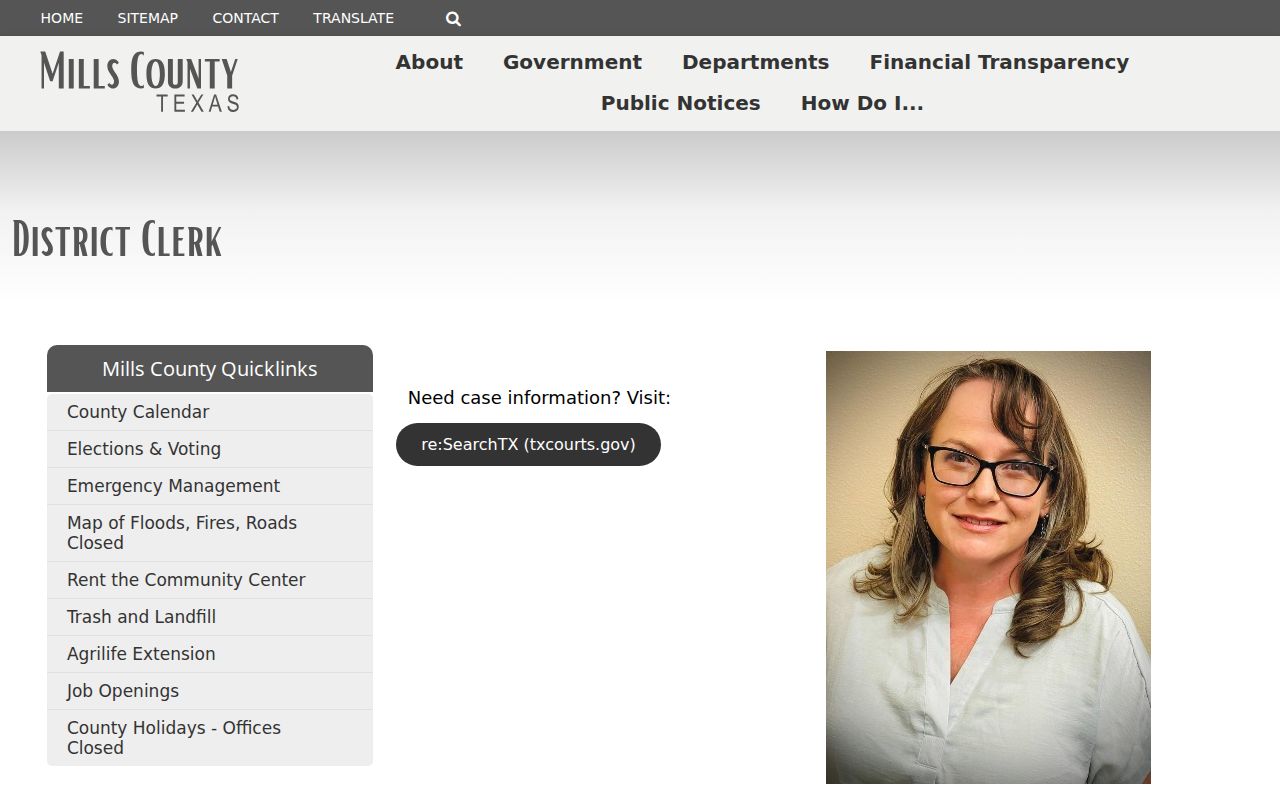
That office page is the sound starting point when a felony cause number or district filing must be tied to the local custodian.
Brown-Mills Criminal Court Split
The 35th Judicial District is shared by Brown and Mills counties. Administrative chambers are in Brownwood, but that address does not move Mills County criminal case records out of Goldthwaite. The Mills County clerk counter at 1011 4th Street keeps the local district pleadings and papers. A person who sees a Brownwood office on the district page should confirm the hearing site before travel and request a Mills file from the Mills clerk.
The 35th District Court page publishes calendars, criminal dockets, local rules, a standing pretrial order, and livestream access.
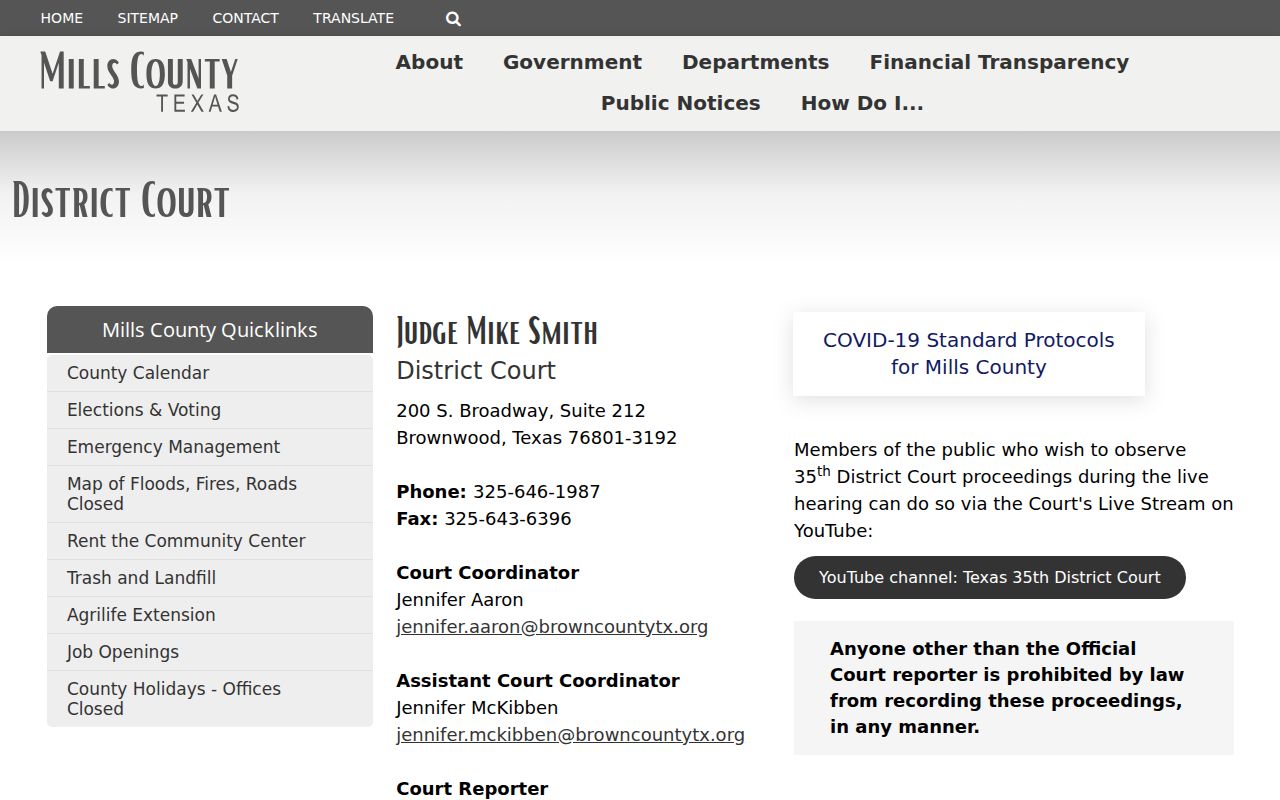
The calendar can confirm when a Mills County case is set, but it is only a scheduling aid. It does not replace the docket, filed pleadings, judgment, or sentence. The court also bars anyone other than the official court reporter from recording a livestreamed proceeding.
Mills County Case Record Searches
Start with an exact case number when one is known. Otherwise, search the statewide court service by person and narrow the result by location, date, and criminal case type. Coverage, document access, and cost vary with court participation and user role. When an online entry is missing or too thin, use the clerk's public terminal, ask staff about the file, or request copies by phone, fax, or mail. The clerk's posted 2026 hours are Monday through Thursday, 8:00 a.m. to 5:00 p.m., and Friday, 8:00 a.m. to 4:00 p.m.
- Open re:SearchTX and select a person or case-number search.
- Enter the exact cause number when available, or use the full name as the search key.
- Apply Mills County, court, criminal-category, and date filters where the interface offers them.
- Read the docket events and document index, then note any access or fee limit on the desired filing.
- Contact the Mills County clerk at 325-648-2711 or P.O. Box 646, Goldthwaite, TX 76844 for a copy, certification, or a file that is not online.
| re:SearchTX control | Type | Required | Use |
|---|---|---|---|
| Person or business | Text | One search key | Find party-name results in participating courts |
| Case number | Text | Alternative | Best exact identifier for one cause |
| Court or location | Filter | No | Narrow to Mills County or the 35th District where supported |
| Date range | Date filters | No | Limit filing or event dates |
| Case category | Filter | No | Select criminal when available |
| Sign in or register | Account | For expanded access | User role affects document access |
Missing Mills Court Case Documents
A blank portal result does not establish that no Mills County criminal case exists. The court may not participate at the needed document level, an older item may not be indexed online, the party name may be entered differently, or a protected case may be restricted. Search again with the cause number and spelling variants. Then call the correct clerk and ask for the criminal search and copy process. The County Clerk also provides a public terminal and a county-document portal described as covering documents from 1998 forward, but official research does not establish that portal as a full criminal-case index.
If the court and the Texas DPS record disagree, obtain the judgment or disposition from the clerk first. DPS builds its history from data submitted by Texas criminal-justice agencies, so a court result may appear before the state repository updates. Certified clerk documentation is the best source for a correction request. A name search can also return a namesake; court, case number, date, and charge should align before treating two entries as the same matter.
Note: A Mills County docket entry may show a warrant event, but the issuing court or sheriff must confirm current status.
What a Criminal Case File Contains
A Mills County criminal case file records formal prosecution, not merely the allegation written at booking. The header identifies the cause, court, filing date, status, and judge. The charging instrument shows what the prosecutor filed, which may differ from the arrest label. Docket events trace motions, hearings, pleas, judgment, sentence, community-supervision orders, later revocation activity, dismissal, or appeal. Some systems also expose costs or payment entries. Document images depend on permissions and fees.
| Cause number and court | The unique filed-case key and the Mills County court with custody |
|---|---|
| Charging document | The complaint, information, or indictment and filed offense level |
| Docket entries | A dated index of filings, settings, motions, pleas, and orders |
| Parties and counsel | The State of Texas, defendant display, and counsel when entered |
| Disposition and judgment | The court's final result, such as conviction, acquittal, or dismissal |
| Sentence and supervision | Confinement, fine, community supervision, or deferred adjudication as ordered |
Protected victim details, sensitive identifiers, sealed material, some juvenile records, and certain exhibits may be withheld or redacted. An index entry is not always a viewable PDF.
Reading Mills County Criminal Dockets
Docket calendars show when matters are set, while the case docket shows what was filed or done. A setting does not prove that a plea, trial, or sentence occurred. Look for a later signed order or judgment. Likewise, “capias issued” records a court event but does not prove that the warrant remains active. The entry may later be recalled or executed, and a live-status check belongs with the court or sheriff.
The Texas Judicial Branch supplies the broader court framework, rules, and state judicial resources used alongside local Mills County sources.
That statewide context helps distinguish trial-court records from appellate records, but the Mills clerk remains the source for a local certified case document.
- Arraignment
- The stage at which the accused is formally advised of the charge and enters or addresses a plea.
- Disposition
- The recorded outcome of a charge or case.
- Deferred adjudication
- Community supervision in which the court defers a finding of guilt under the order's terms.
- Capias
- A court command directing that a person be taken into custody.
Criminal Case Stages in Mills County
After an arresting agency sends a matter forward, the prosecutor decides what charge, if any, to file. The filed instrument creates the court case. Arraignment and pretrial work follow, including counsel appearances, discovery-related steps, motions, and settings. A plea may resolve the charge, or the matter can proceed to trial. The judgment records the disposition, and a sentence or community-supervision order states the consequence. Later motions, revocation proceedings, or an appeal can add new entries to the same case history.
Case flow: Charges Filed › Arraignment › Pretrial › Plea or Trial › Disposition › Sentencing
Each stage leaves a different paper trail. The booking sheet cannot prove what the prosecutor filed, and a calendar cannot prove the final result. Follow the cause number through the docket, then locate the signed judgment and sentence. For the event before filing, the separate Mills County arrest search explains sheriff booking and report channels.
Mills Court Judgments and Federal Appeals
A Mills County state judgment may proceed to the Third Court of Appeals under the governing appellate route. That record is distinct from a federal criminal docket. Federal trial matters arising in Mills County belong in the Western District of Texas, and federal appeals go to the Fifth Circuit Court of Appeals. Search the court named on the pleading instead of assuming that every case involving a Mills resident belongs in the county clerk's files.
The Western District of Texas is the official federal trial-court source for division and court information.
Its records should not be mixed with Mills County's state trial docket merely because both concern criminal proceedings.
For federal electronic dockets and filed documents, use PACER, where account and fee rules apply.
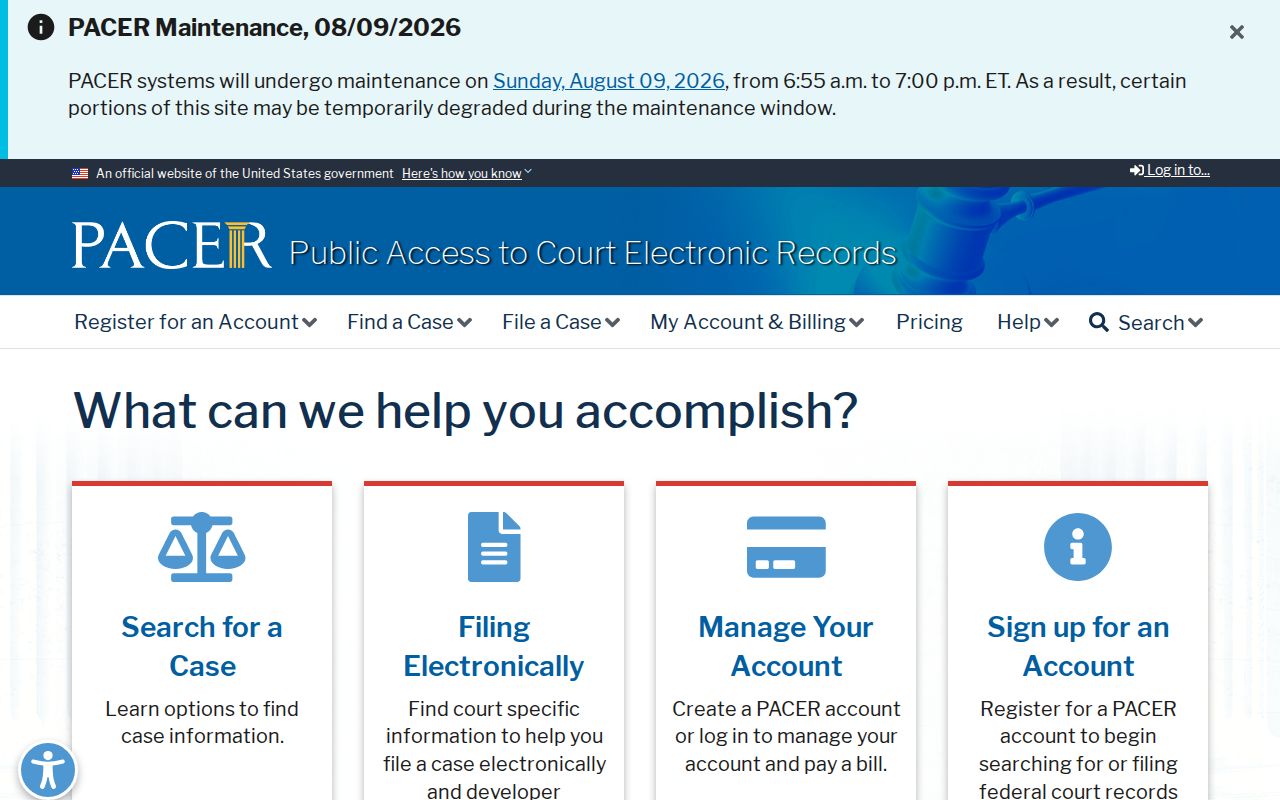
PACER can track an indictment through judgment at the federal level; it does not contain a Mills County state-court case file. The Federal Bureau of Prisons locator covers federal custody, while an FBI Identity History Summary is a personal fingerprint-history product rather than a federal pleading search.
Access Rules for Case Records
Public access does not mean every Mills County criminal case document is free online. Court records follow judicial access rules and clerk law, while a Texas Public Information Act request to the sheriff concerns agency records and is not a substitute for ordering a filed court paper. Portal coverage can vary. Copies, certification, and document access may carry fees, so ask the clerk for the current amount before ordering.
Texas law restricts criminal-history information through Government Code Chapter 411. Nondisclosure orders can limit public release without destroying the underlying record, and Code of Criminal Procedure Chapter 55A governs expunction. Juvenile material follows separate Family Code rules. Victim data, sensitive identifiers, sealed filings, and protected exhibits can also be redacted or withheld.
Resolving Mills County Court Conflicts
When two sources disagree, match the cause number, court, filing date, charge statute, and disposition date. Start with the Mills County clerk because the signed judgment is the court's direct record. Next, compare the DPS entry if the issue concerns statewide history. DPS warns that its repository depends on agency submissions, while name searches can miss or confuse people with similar names. Fingerprints are the sound identity key for a review of one's own complete Texas history.
A missing disposition should be documented through the clerk before using the DPS correction route. If a dismissal, nondisclosure, or expunction is involved, obtain the signed order and confirm which agencies received it. Do not assume that a dismissal erased the arrest cycle or that nondisclosure destroyed the file. Those remedies have different legal effects and eligibility rules.
Mills County Clerk Counter
1011 4th Street
Goldthwaite, TX 76844
325-648-2711
Monday-Thursday 8:00-5:00
Friday 8:00-4:00